Wednesday, October 27, 2010
Entry 3.2
After a long time not being able to decide what part of the many movies made or what scene to choose, I arrived on this part of the movie made in 1971 by Polansky. In this scene Macbeth goes back to meet with the witches begin for help. A large group of witches welcome him to their cave and practice some kind of spell to let him talk to the spirit and know about the future. One thing that stroke me is in the passage where Macbeth has a vision, going from mirror to mirror and finally arriving in a forest. Even though this vision is suppose to show him the long generations of king descending from Banquo, the act of traveling from one mirror to another is very important here, knowing that mirror are seen as windows to different world, here Macbeth keeps jumping from one world to another, with a different Banquo in each and finally the last mirror shows him the horror of his own acts, Banquo stabbed in the back... on the command of Macbeth himself.
Also, before he even drinks the witches potion, Macbeth is taken down in the cave, but one thing this movie adds to the action described in the original book is the fact that the young witches grabbing Macbeth's hand doesn't have to pull him very hard to make him follow her, as if Macbeth was whiling to walk down to hell without hesitation.

Thursday, October 21, 2010
Entry 3.1 Macbeth
For this blog entry about Macbeth, my choices of pictures are these two cross aching drawing. To me they both convey a big part of the uncomfortable mood depicted in the play. This first drawing depicts Macbeth as the coward archetype:
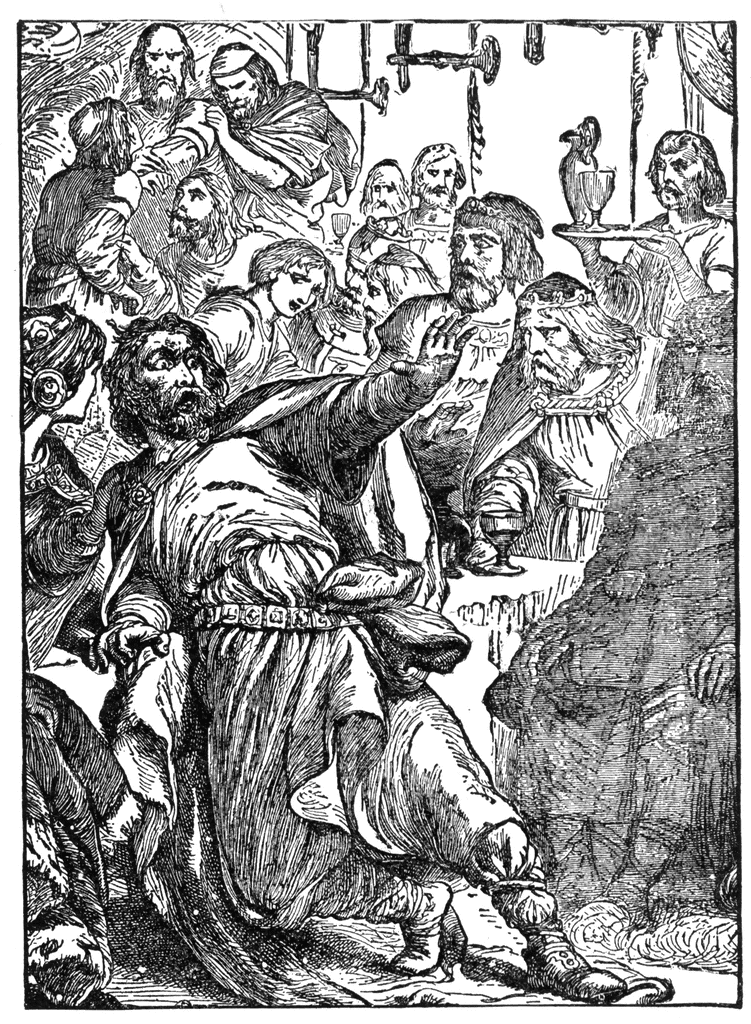
The first one depicts the scene where Macbeth sees the ghost of Duncan in his chair during a feast, this sight terrifies him and Lady Macbeth has to ask their guest to leave. A sticking element in this drawing is how well the artist depicted the fear Macbeth is experiencing, his posture and the very strong sense of dynamic in contrast to the very calm back ground, as if no one even saw his reaction at this very moment makes it a very strong image. Looking at Macbeth's posture we realize his whole body is straight, probably from being frightened, but also the line going from his head to his toes is a diagonal line, usually used by artist to convey an absence of balance and the viewer is usually very affected by it. This use of diagonal join to the plot could be understood as the moment where Macbeth starts his fall from the success of becoming kind. It also depicts perfectly the fact that after becoming king he becomes a lonely man as everyone fears him, the fact that he looks terrified but no one sees him, his very tenses and straight body in contrast to a very relaxed background, and finally the very heavy and dark shadows on Macbeth compared to a very light background.
Macbeth is here the perfect example of the Coward archetype, not wanting to face and assume his acts of violence, his left hand up in the air trying to keep the ghost away. We can also notice his eyes wide open of surprise, but Macbeth had to know this or worth was coming.
The ghost of Duncan represent all of Macbeth's regrets, remorse and feelings of guilt, we cannot know for sure if the ghost actually appears or if Macbeth's guilt is playing games on him.
In this second image, Macbeth is seen as the victim of other's influence:
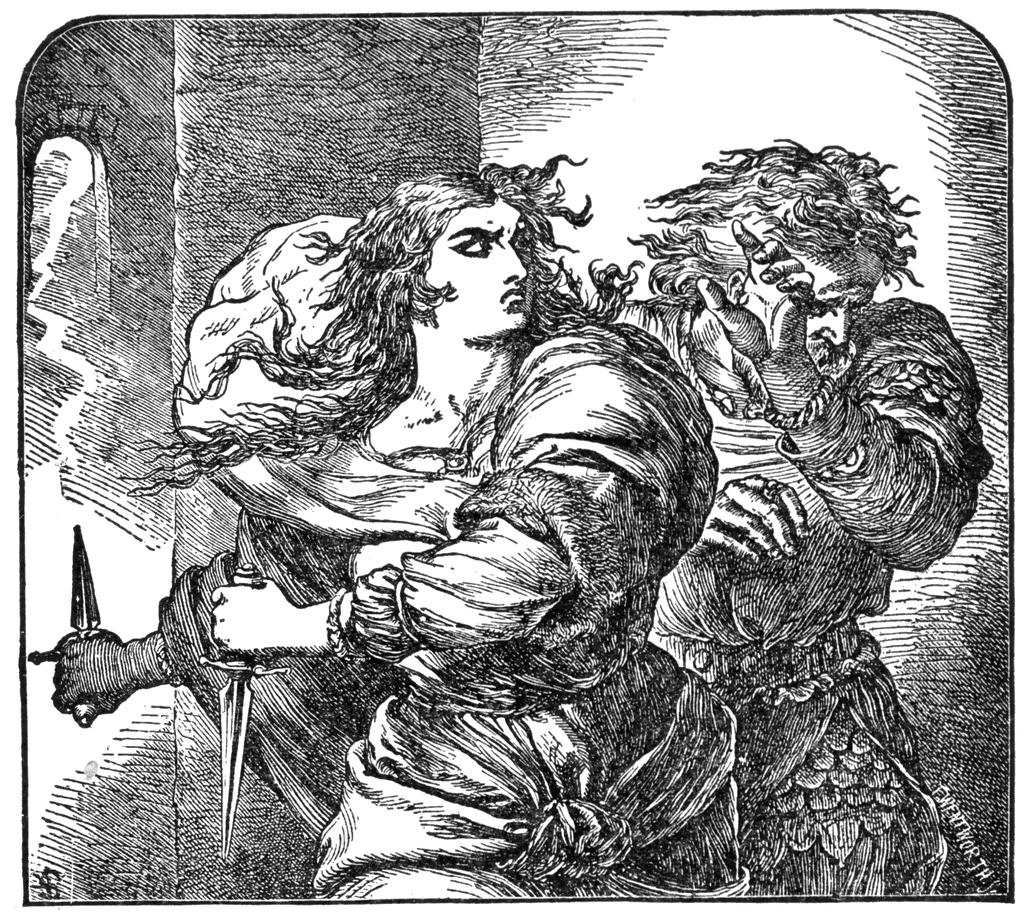
Lady Macbeth is here the focal point, by contrast, line directions, position and much more design techniques used by the artist that we could discuss in details. The artist gives us a perfect visual illustration of the character Macbeth is in this play: a victim easily controlled by other's influence. First the witches who plant the idea of becoming king, then his wife who makes sure he will get to the throne. Looking at this scene, Lady Macbeth is obviously in power, she is holding two daggers, symbolizing her desire to act and not just plan. She is not just holding these daggers, she looks like she just took them off of Macbeth hands who his behind her and hiding his face. The fact that Macbeth is, all throughout the play, controlled by woman could be seen as a sign of weakness, especially back when the play was written by Shakespeare.
These are only two of a long list of archetypes present in Macbeth's character, coward and victim, but not a victim of anyone, only himself. Indeed, Macbeth, by being so easily controllable and so greedy brought all his pain and suffering on himself.
Thursday, October 14, 2010
WesBlack102: Blog Entry 2.2 Altruist
WesBlack102: Blog Entry 2.2 Altruist: "The Altruist The 'Altruist' is a person that is selfless. This type of person wi..."
TheSupernatural: Blog Entry 2.2: ALTRUIST
TheSupernatural: Blog Entry 2.2: ALTRUIST: "According to psychologist Carl Jung, the archetypes are preconscious psychic dispositions. Also, Jung states that they are innate with a pe..."
Wednesday, October 13, 2010
Blog Entry 2.2: From ALTRUIST to WARRIOR!

(There is a very good explanation to the presence of Xena on my blog)
After taking The Heroic Myth Self-Test (by Carol S. Pearson, 1998) I end up being primary an ALTRUIST. For the purpose of this writing I stayed away from all dictionary and definition and kept the definition from my language, french .To me, an altruist is someone who puts others needs before himself, doing everything in his power to help others wether it affects his life. My choice to illustrate this archetype is a picture of Xena, the warrior princess.
Yes, weird choice. I was looking for characters or image that make me think of this precise part of the Hero in our culture and ended up following a classmate's advice and looking up Xena. But when I saw the picture I realized that all hero have, of course, all the archetypes from the Hero Myth, somehow Xena makes me think of the Altruist. When I think of an altruistic person I think of one of these heroes fighting for the good of a victim in danger, but more specifically, I think of the fact that they jump into danger without even thinking. This to me is the very base of an Altruist. In her adventures, Xena always ends up fighting for someone else's life or right and never for herself, which in the end ruins her own life. She is the extreme example of the altruist who almost lives to help others.
Even though my example is quite ridiculous, this helped me understand what this Altruist archetype was about. Without comparing myself to Xena (I could but it wouldn't be very useful here), I can really relate to this archetype, not only because the test gave me this result, but because I have my whole life tried to be a good man and to me the first step was to help others without any asking questions, it wouldn't be mine to judge. I have realized over time that this side of me was affecting my own life and decided to change. The Warrior as a second result may as well be the result of this change towards being a bit more selfish and focusing more on my life while still helping others.
Again, sorry for the really... special choice of example kindly offered by corpossibilidades.blogspot.com
Thanks for reading!
Wednesday, October 6, 2010
Blog entry 2.1 "Goblin's Market or the Creepy Garden of Eden"
The Goblin's Market or the Creepy Garden of Eden
The author of this poem, Christina Georgina Rossetti, was born in 1930 in London. Some of her most famous work is the poem I will be writing about here: Goblin's market, Remember and In the Bleak Midwinter. Knowing that her father was also a poet, we could assume that she was inspired by him and carried on his work. It seems, to me, that the fact that Christina's mother was a nun and with the second sister they both got deeply interested in Anglo-Catholic movement, Christina was strongly influenced by her family, for instance the poem Goblin's Market could be interpreted as a creepy version of the Adam and Eve story. Christina also volunteered in a “house of charity” which seem to have been a strong influenced for this poem, the passage were to Laura gets sicker and sicker and her sister has to do the one thing she refused to do until then is a very good example of the “Fallen women” she help and probably got close to. In this blog entry I will focus on the symbolic and archetypes present here, how they give a great power to this poem and how these elements of our culture put together in this poem can make it a very disturbing work.
As I read this poem, one thing struck me, the fact that this poem has all the elements of the Adam and Eve story: The malefic fruit, the two characters with one staying away from the fruit and the other one succumbing to temptation and the fatal consequences of eating the fruit.
In this poem the two characters are called Laura and Lizzie, two sisters who walk by a goblin's market and hear their calls: “Come buy, come buy”. Laura succumbs to the temptation while her sister Lizzie tries to keep her away from it. Having no money Laura uses a chunk of her own hair to trade, but after eating the delicious fruits her health slowly starts to degrade. After seeing her sister become dangerously sick Lizzie decides to go back to the Goblin's market to buy more the antidote, more fruits, to cure her poor sister who cannot hear or see the goblins anymore. Once there, Lizzie proposes to pay with real money and that when we understand how the spell works, by trading in a part of herself to get fruits Laura had given the Goblins her health and youth. Lizzie has to fight through the goblins who are trying to force-feed her; she finally makes it out of this trap and goes back to her sister to save her from a certain death. Laura being saved, the two sisters go on and have a long life with their respective family.
The symbols in this poem could all be found in the Adam and Eve scene, from the fruit to the snake being here embodied by the goblins.
I will start with “the fruit”. This is the first element that made me compare this poem to the Garden of Eden. The very complex description of this fruit and its malefic consequences, which looks delicious but is deadly, is extremely close to the role of the fruit from Adam and Eve's story. This symbol is pretty clear here, the fruit as the decadence of humanity or the end of purity according to the bible. The trade Laura makes is very interesting symbolically. She gives up a piece of her hair, which is our cosmic connection, to pay for the fruits. The evil is, in this poem, represented by a group of goblins, all with different faces and looks: Cat, rat, snail and wombat. These animals bring a notion of magic (for the cat) and creepiness or ugliness (rat and snail), but then the poem follows with: dove, love, pleasant, kind; giving the opposite impression about these characters. This description gives the goblins a very evil look but a pure and kind personality. Again, I can't help comparing these goblins to the snake: a scary and creepy body with the skills to sounds and appear kind and caring.
The archetypes present in this poem are all also to be found in Fairy tales, or the Heroic Monomyth theory.
In fact, a fairy tale’s structure would almost always be: A character in danger (mostly princesses), an evil character or monster (usually a dragon or any creepy and scary creature), the savior (whiling to do go through any danger for the endangered princess, usually out of love), a enchanted place or scene and finally the happy ending with love, marriage and lots of kids.
Christina Rossetti here, proposes us a very disturbing and sexual fairy tale on the base of Adam and Eve theme:
The enchanted place: a very random back country scene made unreal by the presence of goblins.
The princess in danger: also one of Young's basic archetypes is here Laura who succumbs the temptation. In this poem Laura also takes on another role: the Fool. By eating the fruit knowing something evil will probably come out of it.
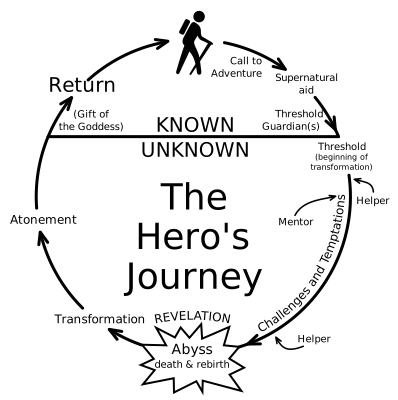
The Savior/Hero: Lizzie here takes on this very important role, she starts of as the prudent almost coward character but ends up as the strongest one who save her sister only out of love. Here is an interesting scheme showing the steps Lizzie takes towards becoming the hero:
 In this circle our hero goes from being called to adventure but takes a little while to decide and jump in, then she passes straight to the danger and almost death, which changes her without being said, the change being in our opinion of her. She finally returns. The Known and Unknown notion are also followed as shown in the scheme since Lizzie doesn't know what to expect.
Evil: The goblins, taking on all the archetypes possibly given to this notion of evil: Destroyer, pervert, murderer, betrayer... and much more. They all act as one same person becoming an archetype not only representing many other archetypes but also many symbols.
The happy ending: Once Lizzie saves Laura the ending becomes the perfect fairy tale happy ending with a La Fontaine moral: Frustration could save you.
It seems like what Christina wants us to get here is the original sin moral, but pushed further. By mixing a creepy poem with the Adam and Eve story but also adding this fairy tale’s structure, the author created an even stronger story full of archetypes and symbols. Each action, each description could be broken down into many different meanings. The religion, the decadence Christina has been close to explodes in this poem.
But to me this poem reminds us of the hope still possible for human. Even though the bible describes Eve eating the fruit as the end of purity, the author here goes against this idea and makes it a fairy tale like happy ending with the two main characters getting married, lots of kids and happiness.
Citations:
- Wikipedia: Christina Rossetti
Wednesday, September 29, 2010
Blog Entry 1.3
Because I could not stop for Death
by Emily Dickinson
Because I could not stop for Death
He kindly stopped for me
The Carriage held but just Ourselves
And Immortality.
We slowly drove, he knew no haste
And I had put away
My labor and my leisure too,
For his civility.
We passed the School, where Children strove
At recess in the ring
We passed the fields of gazing grain
We passed the setting sun.
Or rather, he passed us
The dews drew quivering and chill
For only Gossamer, my gown
My tippet only tulle.
We paused before a house that seemed
A swelling of the GROUND
The roof was scarcely visible
The cornice in the ground.
Since then 'tis centuries and yet
Feels shorter than the DAY
I first surmised the horses' heads
Were toward eternity.
My choice for this entry is the poem “Because I could not stop for death” by Emilie Dickinson. This famous author of the 19th century wrote a lot of poems about Death.
As confusing as this poem was after my first reading, I realized how much there was to it as I started searching for symbols and clues to understand.
First of all, the title confused me more than anything, “Because I could not stop for death” gives the subject matter of this poem, but also a sense rush. But does it mean the author is trying to escape death or is it a reference to others death and not being able to stop and cope for their death?
The first stanza then starts off with the title, with this same confusing idea of death being a person. It almost feels like the author would have stopped for death if she had a chance, but she didn't. In only one verse the author puts herself in control of Death, as if she was the one controlling whether or not she wanted to give time to Death.
To most of us, Death is a scary and taboo subject, we seem to always personify it as one entity that would come and take us away. But here the author makes it a person that we get close to as the poem goes. In the second verse the speaker who didn't have time to stop for Death ends up having the luxury of having Death stopping for her. Death is even described here as “kind”, as if Death, was a gentleman stopping to pick up a hitchhiker. So far, the mental image that I made of this scene is the speaker walking along an empty road, Death coming with a Carriage and taking time to stop for her. But then a third character comes in this scene, Immortality. Again, the notion that exists in our culture is defined here as a person. We now have the author sitting next to Death depicted as a gentleman and in the back, Immortality, all sitting quietly. What strikes me in this first stanza is the absence of description. We have an image of three characters sitting on a “carriage”, but no landscape or anything around, as if there was actually nothing surrounding the scene.
The second stanza gives us a bit more information about this scene, the carriage is moving slowly (“he drove slowly”, “he knew no haste”), we now have motion clues added to our scene. Then giving the favor back to Death, the speaker “puts her labor and leisure away”to make it an amicable ride. In only two stanzas the relationship between Death and the speaker became civil. It almost seems like this poems could have been made to make the speaker itself feel more comfortable around death.
The third stanza finally brings a background to this scene: “a school where children strove at recess in the ring”. This verses bring the notion of the beginning of life. Then using the repetition of “passed” the speaker takes us through a field of “gazing grain” and “a setting sun”. Again, by personifying the grain the speaker makes it a striking visual element. Giving the grain a human reaction to their passage and using the visual element of the sun, the speaker sets up a bright and shiny grain field that looks alive. In this stanza, the author takes us through the cycle of life with the children as the notion of youth, the grain as life and the sun as eternity.
Continuing with the sun, the speaker then emphasis the fact that the sun is eternal “or rather he passed us”. Not only does the speaker makes it a person but it is also a reminder that the sun is a much bigger entity, to me this one line is the most powerful one. The sun being what our planet depends on and being much bigger, it reminds us of how short and little our life is compared to this eternal planet. Then a textural clue is added. “The dews drew quivering and chill”. This cold and humid texture contrast with the worm and shiny sun used in the preceding verse. Knowing that the speaker is sitting next to Death, this notion of “chill” only makes sense to me and brings back our cultural beliefs concerning death. We also get a sense of time, or should I say confusion about time. There was a sun set in the last verse and the “dew” is already there “quivering and chill”. Isn't the dew suppose to come later in time? How much time as gone by? But again, we are in presence of Death and immortality, a complete unrealistic scene where opposites meet. The end of this stanza brings us visual clues about the speaker. “For only Gossamer, my gown My tippet only tulle.” For such a ride, with Death and Immortality, the author seems to be wearing very formal cloth. The “tippet” is what makes her outfit so formal, as if she was attending an important event. Knowing that she is riding in a carriage with Death and Immortality, this makes it a very “last ride” kind of image.
The fifth stanza brings us to a strange looking house. But first another notion of motion stops us there:”we paused before a house”, show us that the carriage driven by Death actually stopped to look at this house, this must be an important house or a very meaningful one. The way the speaker describes this house gives an image of a tomb, an old one bitten by time and taking roots into the ground. The house, or shall I say “tomb” seems to be coming out of the ground (“swelling”) and it seems like earth is trying to suck it back in. Knowing that the house is a continuation of our body, this image of a tomb seems to represent a tomb enclosing not only our body but also our life. This image being used after the children in third stanza, the grain field and the sun in the forth and fifth stanza, emphasis the idea of cycle of life. Going from youth (or birth) with the children, to life and eternity with the grain and the sun to finally a creepy vision of death with the house described as a tomb, we now have gone through all stages of this cycle from birth to death.
Finally in the last stanza, the speaker gives us yet another clue of time, but only to break our notion of time: “Since then 'tis centuries and yet Feels shorter than the DAY”. This two lines change this short trip into an endless one. Then again with the last lines it seems that the carriage is heading towards eternity.
Subscribe to:
Posts (Atom)